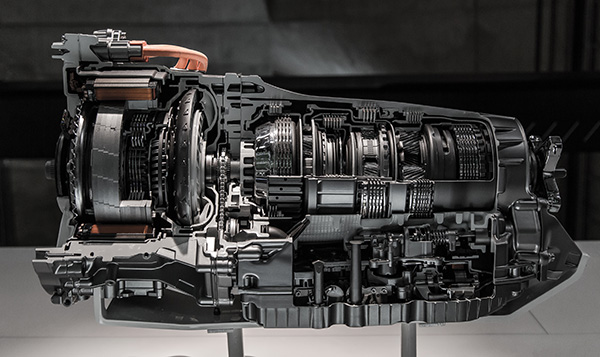
Transmission temperature is something most drivers rarely think about until a warning appears or a repair is needed. Yet every time an automatic transmission moves the vehicle away from a stop, changes gear ratios, or works under load, heat is being produced inside the unit.
How manufacturers control that heat varies considerably from one vehicle to another. Looking through the grille and spotting a small heat exchanger doesn't necessarily tell the whole story. Some cooling components are hidden inside other assemblies, while certain vehicles use more than one method of controlling transmission temperature.
How an Automatic Transmission Produces Heat
Automatic transmissions contain clutches, bearings, gears, hydraulic circuits, and other components operating in transmission fluid. Conventional automatics also commonly use a torque converter, which transfers engine power through fluid and can produce considerable heat under certain operating conditions.
Heat generation rises when the transmission works harder. Towing, climbing grades, repeated acceleration, slow traffic, high ambient temperatures, and heavy loads can all increase thermal stress. Transmission fluid has to remain within an appropriate operating range because excessive heat can accelerate fluid deterioration and affect lubrication and hydraulic operation.
So, Does Every Automatic Transmission Have a Separate Cooler?
No. Automatic transmissions require some method of managing temperature, but that does not mean every vehicle has a separate air-to-oil cooler mounted in front of the radiator.
Many vehicles cool transmission fluid through a heat exchanger incorporated into the radiator. Others use a separate external cooler. Some have both. Newer designs may use compact liquid-to-liquid heat exchangers connected to the engine cooling system, and the exact arrangement can vary even between different versions of the same vehicle.
The Radiator Can Contain the Transmission Cooler
A traditional setup routes transmission fluid through a heat exchanger located inside one of the radiator tanks. Engine coolant and transmission fluid remain in separate passages, but heat transfers between them.
When the transmission is hot, the cooling system helps remove heat from the transmission fluid. This setup can also help the transmission reach operating temperature after a cold start because warmed engine coolant can transfer some heat back toward the transmission fluid.
From outside the vehicle, there may be no obvious standalone transmission cooler to see. The cooling function is taking place inside the radiator assembly.
Some Vehicles Have a Separate External Cooler
An external transmission cooler usually looks like a small radiator and is often mounted where it receives airflow through the front of the vehicle. Transmission fluid moves through its passages, releasing heat to the surrounding air.
Manufacturers may install an external cooler when the vehicle's design, powertrain, expected load, or towing capability requires additional heat rejection. Trucks, SUVs, performance vehicles, and vehicles equipped with towing packages are common places to find more extensive transmission cooling, although the exact equipment depends on the model.
A Vehicle Can Use Both Cooling Methods
Some automatic transmissions route fluid through a radiator-mounted heat exchanger and then through an auxiliary cooler. Using both can provide temperature management across a wider range of operating conditions.
The system may also include thermostatic valves or bypass circuits that control when fluid travels through certain cooling passages. Sending cold transmission fluid through maximum cooling capacity immediately after startup is not always desirable because the transmission also needs to reach its intended operating temperature.
That is why adding or rerouting a cooler without understanding the original system design can create unintended problems.
Liquid-to-Liquid Heat Exchangers Are Common on Modern Vehicles
Not every transmission cooler relies directly on outside air. A compact heat exchanger may circulate transmission fluid on one side and engine coolant on the other.
These units can be mounted directly to the transmission or nearby. Their compact size makes them easy to overlook during a visual inspection, but they can have an important role in both warming and cooling transmission fluid.
Modern electronically controlled transmissions are designed around specific temperature ranges, so the cooling system is often more integrated with powertrain management than older designs were.
CVTs and Dual-Clutch Transmissions Have Cooling Needs Too
Continuously variable transmissions and dual-clutch transmissions are different internally from conventional automatics, but they still generate heat and may require dedicated fluid temperature control.
A CVT may use a fluid-to-coolant heat exchanger, an external cooler, or a combination depending on the application. Certain dual-clutch units also circulate fluid through cooling systems designed specifically for their operating requirements.
For that reason, identify the cooler configuration by the exact vehicle and transmission rather than assuming every automatic-style transmission uses the same arrangement.
When an Auxiliary Transmission Cooler Can Be Useful
An additional cooler can sometimes be beneficial when a vehicle is used for towing or operates regularly under demanding conditions. However, installing the largest cooler available is not automatically the best approach.
The transmission needs correct fluid flow and temperature control. Cooler size, plumbing location, pressure drop, thermostatic control, vehicle airflow, and manufacturer recommendations should all be considered. On some vehicles, the factory towing package already includes different cooling hardware from the standard model.
Before adding equipment, it is worth checking what the vehicle already has and whether the manufacturer specifies additional cooling for the intended use.
Transmission Cooler Problems Can Cause Serious Symptoms
Cooling problems are not limited to an overheated transmission. Cooler lines can leak, fittings can corrode, heat exchangers can become restricted, and damaged external coolers can lose fluid after an impact.
Possible warning signs include:
- Transmission temperature warnings
- Fluid leaking near cooler lines
- Burnt-smelling or discolored transmission fluid
- Changes in shifting after prolonged driving
- Overheating during towing or hill climbing
- Visible damage to an external cooler
- Repeated transmission temperature problems in traffic
These symptoms do not prove that the cooler is responsible, but they justify checking the complete transmission cooling system.
What Happens if a Radiator-Mounted Cooler Fails Internally?
Because some transmission heat exchangers are located inside the radiator, an internal failure can potentially create contamination between cooling circuits. Depending on the design and failure, transmission fluid and engine coolant may end up where they do not belong.
Contamination should be addressed promptly because both systems depend on fluids with very different properties. Repair may involve more than replacing the radiator or heat exchanger if contaminated fluid has circulated through the transmission.
Regular maintenance that includes checking fluid condition and watching for unexplained changes can help catch developing concerns. An inspection is especially worthwhile if fluid color changes unexpectedly or the transmission begins behaving differently after a cooling-system problem.
Get Transmission Cooling System Service in Olympia, WA, With Olympic Transmissions & Auto Care
Olympic Transmissions & Auto Care in Olympia, WA, can evaluate transmission coolers, heat exchangers, cooler lines, fluid condition, and transmission temperature concerns.
If your vehicle is overheating under load, leaking transmission fluid near a cooler line, or you are considering additional cooling for towing, contact Olympic Transmissions & Auto Care to schedule service.